-1779805773906-868231420.png "CyOpsPath logo")

I run a job board. Connect with me on LinkedIn, and follow me on Instagram for career insights that are actually worth your time.
I talk to recruiters, hiring managers, and job seekers every single week. And for the past 18 months, I watched the same pattern play out over and over again: a company announces it is replacing a team with AI, engineers cheer, shareholders applaud — and then, quietly, six months later, that company posts the exact same job opening it just eliminated.
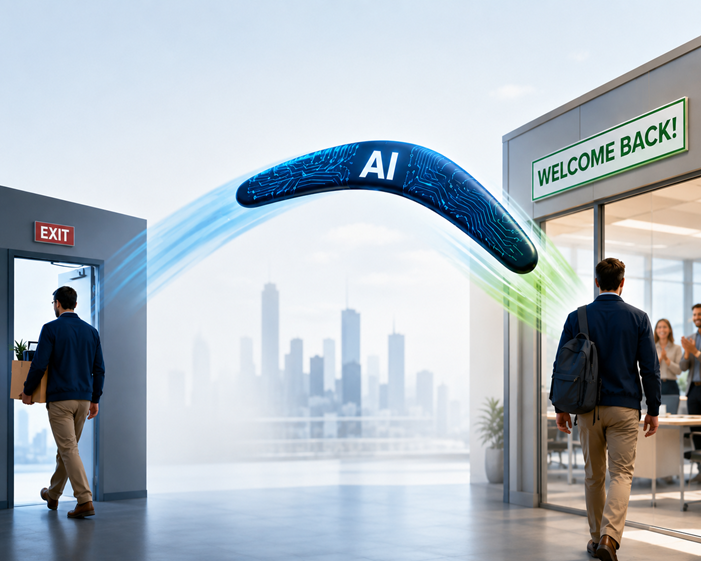
We now have a name for it: the AI Boomerang.
And the data behind it should give every job seeker on the market right now genuine, evidence-backed hope.
The Numbers First
Before we get into the story, let the data speak.
29% of companies that cut staff after implementing AI have already rehired for those exact positions — Robert Half, 2026
55% of executives now openly admit they regret replacing human workers with AI — Orgvue and Forrester
55,000 U.S. jobs were attributed to AI-driven layoffs in 2025 alone — Challenger, Gray and Christmas
Two-thirds of HR professionals whose organisations made AI-driven cuts have already brought some of those employees back — Careerminds
This is not a trickle. This is a structural reversal happening across industries, right now, in real time.
What Actually Happened — and Why It Failed
In 2024 and early 2025, companies ran what seemed like a straightforward playbook: fire humans, deploy automation, collect the savings. Klarna bragged publicly about replacing 700 customer service agents with AI. Block cut nearly half its entire workforce, citing deep investment in AI systems. Pinterest eliminated 15% of its staff specifically to redirect budget toward its AI transformation. These were not quiet decisions — they were press releases.
Wall Street applauded. Efficiency ratios improved on paper. CEOs went on CNBC to talk about headcount reduction as a competitive advantage.
And then reality arrived.
Forrester found that when companies made those cuts, 9 out of 10 of them did not have a mature, production-ready AI system to fill the gaps they created. They fired the people before the replacement actually worked. In many cases, the replacement never worked the way the demos suggested it would. Customer satisfaction dropped. Error rates climbed. Processes that looked simple from the outside turned out to depend on years of undocumented human judgment that no one had thought to capture before clearing the desks.
There was another layer to this that only surfaced later. Forrester's 2026 Predictions report found that nearly 6 in 10 hiring managers now admit that AI was cited as the official reason for layoffs that were actually driven by budget shortfalls, revenue uncertainty, and the need to unwind the aggressive overhiring that happened during the 2021 and 2022 boom years. Sam Altman himself publicly acknowledged the phenomenon. Analysts gave it a name: AI washing. Companies used the AI narrative as cover for cuts they needed to make for entirely conventional financial reasons.
The result is the moment we are in right now — a widespread, if quietly managed, reversal.
Why Companies Are Shifting Back to Human Hiring
The rehiring trend is not sentimental. Companies are not bringing people back because they feel guilty. They are bringing people back because the business case for pure AI replacement collapsed under the weight of real-world evidence. Here is exactly why the shift is happening.
1. AI Could Not Handle Complexity at Scale
AI tools perform beautifully in controlled demos and on narrow, repeatable tasks. They fall apart when the situation is ambiguous, the customer is frustrated, the data is messy, or the decision carries legal and reputational consequences. Customer service teams that replaced agents with chatbots watched satisfaction scores collapse. Legal teams that eliminated paralegals found AI-generated research riddled with confident, plausible-sounding hallucinations. Finance teams that cut analysts discovered models producing wrong numbers with no one left qualified to catch them before they reached a client.
2. The Hidden Costs Wiped Out the Projected Savings
Executives sold AI-driven layoffs to boards as clean cost reduction. What the initial spreadsheets failed to account for were the costs that arrived afterward: severance packages, knowledge drain, recruiter fees for replacement hires, extended onboarding periods, productivity gaps during the transition, and reputational damage that made top candidates reluctant to join companies with a track record of overnight mass cuts. In a significant number of cases, the total cost of the full cycle — cut, fail, rehire — exceeded what simply retaining the original employees would have cost.
3. Institutional Knowledge Left the Building and Did Not Come Back on Its Own
This is the one that stings most. When experienced employees walk out the door, they take with them years of undocumented context — why a process works the way it does, which clients need careful handling and why, where the edge cases live, how to read between the lines of a brief, how to navigate the unwritten rules of a long-standing vendor relationship. You cannot feed that knowledge into a language model by scanning a shared drive. You rebuild it only one way: by hiring experienced people back, often at significantly higher compensation than before.
4. Regulators and Customers Started Pushing Back
Governments across the United States, the European Union, and Asia are tightening AI accountability frameworks at pace. When an automated system makes a consequential wrong call — a denied insurance claim, a biased hiring screen, a flawed financial recommendation — regulators ask one direct question: who is responsible? The answer cannot be "the algorithm." Companies need qualified humans in the loop not just for performance reasons, but for legal cover. Compliance requirements alone are driving headcount back up across financial services, healthcare, and legal technology.
5. The Humans-Plus-AI Model Is Outperforming Pure Automation
The companies that never went all-in on replacement are quietly outpacing the ones that did. PwC's 2025 Global AI Jobs Barometer, drawing on analysis of nearly one billion job postings across six continents, is unambiguous: industries most exposed to AI that kept and upskilled their workforce are generating three times higher revenue per employee than those that did not. IKEA automated half its customer calls and invested the resulting savings into upskilling all 8,500 workers rather than eliminating them. Customer satisfaction improved. Retention strengthened. The human-plus-AI model wins, and the companies that went the other direction are now spending to catch up.
6. Talent Scarcity Arrived Faster Than Anyone Predicted
Here is the irony that did not get nearly enough attention: the skills companies need to run, manage, and continuously improve their AI systems are held by experienced humans. AI model evaluation, prompt engineering, output quality assurance, workflow integration, and the change management required to actually embed AI into an organisation — all of this requires people. The pipeline of people with those skills is far thinner than demand warrants. Companies that gutted their technical and operational teams are now competing for a scarce talent pool, frequently paying significantly more than they saved in the original reduction.
7. Employee Trust Became a Measurable Business Risk
The loudness of AI-driven layoff announcements created a trust problem that spread well beyond the employees who were actually cut. Gallup data and multiple workplace surveys from 2025 show that engagement dropped sharply at companies known for AI-driven workforce reductions. The employees who remained worked with one eye permanently on the exit. Top performers — the ones with the most options — left proactively rather than waiting to find out if they were next. Companies discovered quickly that how you treat people on the way out determines the quality of people you can attract on the way in.
The Data Every Job Seeker Needs to See
Here is the part that rarely makes the headlines, because it does not fit the fear narrative that generates clicks.
PwC's research found that between 2019 and 2024, even the most highly AI-exposed occupations still saw 38% job growth. Workers with demonstrated AI skills now command a 56% wage premium — more than double the 25% premium recorded just a year earlier. Wages in AI-exposed industries are rising twice as fast as in non-exposed industries. Job numbers are growing in virtually every AI-exposed occupation, including the ones considered most automatable.
Gartner projects that by 2027, roughly 50% of the companies that cut too aggressively will be actively rehiring to fill talent gaps, with particular demand at the mid-management and specialist layers where human oversight of automated systems is most critical.
The market is not shrinking for skilled humans. It is reorienting. And the reorientation is creating genuine opportunity for candidates who understand what is actually happening.
What Job Seekers Should Look For Right Now
If you are back on the market — whether you were directly affected by an AI-driven reduction or simply reading the signals carefully — here is the practical guidance I give every candidate in my network.
Target AI-Plus-Human Roles, Not Just AI Roles
Titles like AI Operations Lead, AI Quality Analyst, Prompt Engineer, Human-in-the-Loop Specialist, and AI Workflow Manager are all boomerang creations. These positions exist precisely because pure automation failed. They are not temporary. They are growing. And the companies filling them are motivated hirers who already understand the cost of getting this wrong.
Look for Companies in Their Second Wave
If a company made loud, public AI-driven cuts in 2024 or 2025, it is now quietly rebuilding. These organisations have already lived through the failure of the replacement experiment. They are not looking to repeat it. They want experienced people who can combine domain knowledge with the ability to work intelligently alongside automated systems.
Prioritise Industries With Genuine AI Exposure
Finance, healthcare technology, legal tech, enterprise SaaS, and advanced manufacturing are all demonstrating the three-times productivity lift that PwC documented. These sectors are hiring humans to direct, evaluate, and improve AI systems — not to be replaced by them. The roles are substantive, the compensation is rising, and the growth trajectory is strong.
Ask One Question in Every Interview
"How is your team working alongside AI tools today?" That single question separates companies with a coherent, tested strategy from those still running unstructured experiments on their workforce. You want to work for the former. The answer will tell you everything about whether the organisation has learned from the past two years or is still repeating the same mistakes.
Watch for Upskilling Investment as a Signal
Forrester found that only 23% of companies offered any kind of AI workflow training in 2025. The ones that do are building teams for the long term and they make significantly better employers. When a company invests in making its people more capable with AI tools, it signals that it views its workforce as an asset to develop, not a cost to minimise.
How to Update Your Resume for This Moment
The resume that got you hired in 2022 will not perform the same way against an AI-assisted ATS screen in 2026. Here is how I advise candidates to reposition right now.
1. Lead With AI Fluency, Specifically
Add a concise Tools and Platforms section near the top of your resume. List every AI tool that is genuinely part of your workflow — ChatGPT, Copilot, Claude, Salesforce Einstein, Notion AI, whatever is relevant to your domain. Do not bury this in a general skills section at the bottom. Recruiters scan for it in the first six seconds and move on if they do not find it.
2. Quantify Your AI-Augmented Output With Real Numbers
Vague claims carry no weight. "Used AI tools to improve efficiency" tells a recruiter nothing. "Reduced weekly report generation time from three days to four hours by integrating AI-assisted drafting into the production workflow" is concrete, credible, and immediately differentiating. If you do not yet have a quantified example, build one before your next application.
3. Reframe Your Human Skills as AI-Oversight Skills
Judgment, stakeholder communication, ethical decision-making, contextual reasoning, and the ability to identify when an automated output is confidently wrong — these are exactly the capabilities AI cannot replicate and that every boomerang-hiring company is now paying a premium for. Do not leave them implied. Name them explicitly. Describe specific moments where your expertise directed, corrected, or materially improved an automated process.
4. Address Layoff Gaps Directly and Confidently
If you were part of an AI-driven workforce reduction, say so clearly and move forward. A line such as "Navigated AI-driven restructuring — actively building AI-augmented capabilities for the next chapter" reads as honest and self-aware. Hiring managers in 2026 understand the context. What they want to see is that you used the time purposefully. A course, a certification, a side project, or freelance work all demonstrate forward momentum.
5. Mirror the Exact Language of the Job Description
AI-assisted applicant tracking systems parse keyword frequency before a human ever sees your application. If the job description uses the phrase "prompt engineering," use that exact phrase. If it says "AI-assisted analysis," mirror it precisely. Generic resumes written for a general audience fail at the screening layer regardless of how strong the underlying experience is.
6. Synchronise Your LinkedIn Profile Before You Apply
Recruiters cross-reference your resume and LinkedIn profile immediately. Inconsistencies create doubt. Keep both current, consistent, and rich in the keywords relevant to your target roles. Add a Featured section that showcases AI-related projects, certifications, portfolio work, or thought leadership posts.
The Window Is Open Right Now
We are sitting at a rare inflection point, and I want to be direct about what it means.
Companies overcorrected in 2024 and 2025. They cut too deep, too fast, with tools that were not ready and strategies that had not been tested against real-world complexity. The AI boomerang is not a minor footnote. It is a structural correction reshaping hiring across industries simultaneously, and it is creating genuine openings for experienced professionals who understand the shift.
The fear narrative — that AI is coming for every job and there is nothing to be done — is not supported by the evidence. The PwC data, the Forrester data, the Robert Half data, and the Gartner projections all point in the same direction. Skilled humans who build visible AI fluency are in growing demand, earning higher wages, and positioned for stronger long-term career trajectories than at almost any point in the past decade.
You do not need to compete with AI. You need to become the person who makes AI useful, reliable, accountable, and genuinely valuable inside a real organisation. That is not a narrow skill set reserved for engineers. It describes any experienced professional who has spent the past 18 months paying attention and adapting.
The roles are being posted. The companies are motivated. The window is open.
Browse the latest tech and ops jobs on CyOpsPath: https://www.cyopspath.com/browse-jobs
Frequently Asked Questions
What is the AI Boomerang hiring trend?
The AI Boomerang refers to the pattern of companies laying off workers by citing AI-driven efficiencies, then reopening and rehiring for those same roles months later. A 2026 Robert Half study found that 29% of companies that made AI-driven cuts have already reversed the decision. The trend reflects the gap between what companies expected AI to deliver autonomously and what it actually produces without experienced human oversight in place.
Why are companies rehiring workers they let go because of AI?
Most companies that made aggressive AI-driven cuts did not have production-ready systems to fill the operational gaps they created. Forrester found that 9 in 10 lacked the AI infrastructure to do so at the time of the layoffs. Beyond readiness, 55% of executives now admit they regret the decision outright, and about two-thirds of affected HR teams have already brought some of those employees back. The combination of operational failure, hidden costs, lost institutional knowledge, and regulatory pressure has made the reversal economically necessary.
Is this trend limited to the technology industry?
No. While the AI boomerang is most visible in tech, customer service, finance, and content operations, the underlying dynamic is cross-industry. Any sector that moved quickly to replace experienced workers with automated systems before those systems were genuinely ready is now navigating the same correction. Healthcare technology, legal tech, and enterprise operations are all seeing meaningful rehiring activity.
Were some AI layoffs not actually about AI at all?
Yes, and it is now well documented. Forrester's 2026 Predictions report found that nearly 6 in 10 hiring managers admit AI was cited as the official reason for layoffs that were actually driven by budget pressure or the need to correct post-pandemic overhiring. This AI washing inflated the headline layoff numbers while obscuring the real financial drivers.
Should I still be worried about AI replacing my job?
The honest answer is that adaptation matters more than worry. PwC's research found that highly AI-exposed occupations still grew 38% between 2019 and 2024. Workers who build visible AI fluency command a 56% wage premium. The genuine risk is not AI replacing you directly — it is another human who demonstrates stronger AI fluency replacing you. That is real, addressable, and well within your control.
What kinds of roles are actually growing right now?
Roles that combine domain expertise with AI oversight are the fastest-growing category. This includes AI Operations Lead, Prompt Engineer, AI Quality Analyst, Human-in-the-Loop Specialist, and AI Workflow Manager across virtually every vertical. Experienced professionals in finance, legal tech, healthcare technology, and enterprise SaaS who demonstrate clear AI fluency are in strong and growing demand.
How do I explain an AI-driven layoff gap on my resume or in interviews?
Address it directly, briefly, and with forward momentum. A line such as "Navigated AI-driven workforce restructuring — actively upskilling in AI-augmented workflows" works far better than leaving the gap unexplained. Hiring managers in 2026 understand the context completely. What they are evaluating is whether you used the period purposefully.
What is the single most important thing to add to my resume right now?
One specific, quantified example of AI meaningfully integrated into your workflow. Not "familiar with AI tools" — that phrase registers as noise. A statement like "Integrated AI-assisted drafting into weekly client reporting, reducing turnaround from three days to four hours" is concrete, verifiable, and immediately differentiating from the majority of applications.
How long will this rehiring window last?
Gartner projects rehiring pressure continuing through at least 2027 as companies fill the talent gaps created by over-aggressive automation decisions. The professionals who move now — updating their positioning, building visible AI fluency, and targeting the right sectors — will be best placed regardless of how the timeline unfolds.
Where can I find the latest tech and ops jobs from companies that are actively hiring?
CyOpsPath lists verified tech and operations roles updated weekly, sourced from companies that are building teams rather than cutting them.
Weekly newsletter
Get the latest blog updates, practical hiring insights, and featured reads delivered straight to your inbox.
Read about our Privacy Policy.