 (1)-1791555126908-668402804.png "CyOpsPath logo")


Hi, I’m Akshata Bhat — a former Talent Acquisition professional, founder of a job marketplace, and LinkedIn Thought Leadership Strategist helping executives build their voice and influence.
Here, I share insights on careers, hiring, the evolving job market, and what I’m learning while building along the way.
Follow my journey on LinkedIn and Instagram.
Now, let’s dive in.
Nobody Told You DevOps Is the Highest-Paying Job Title Companies Are Desperate to Fill (And Still Can't)
Say "DevOps Engineer" at a dinner party and you'll get a polite nod, maybe a "so... IT?" It's one of the most misunderstood titles in tech. People think it's a buzzword, a rebranded sysadmin, or a job that AI is about to erase. None of that is true. In 2026, DevOps quietly became one of the most stable, well-paid, and hardest-to-fill roles in the industry — and almost nobody outside the field is talking about it.
Is DevOps Really Just a Buzzword?
The myth goes like this: DevOps is just a fancy name for "the person who deploys stuff," a generalist role with no deep expertise, easily replaced by cloud automation or AI copilots. It's the tech world's most underrated job title — dismissed by outsiders while quietly running the infrastructure every app, bank, and hospital system depends on.
So What Do the Numbers Actually Say?
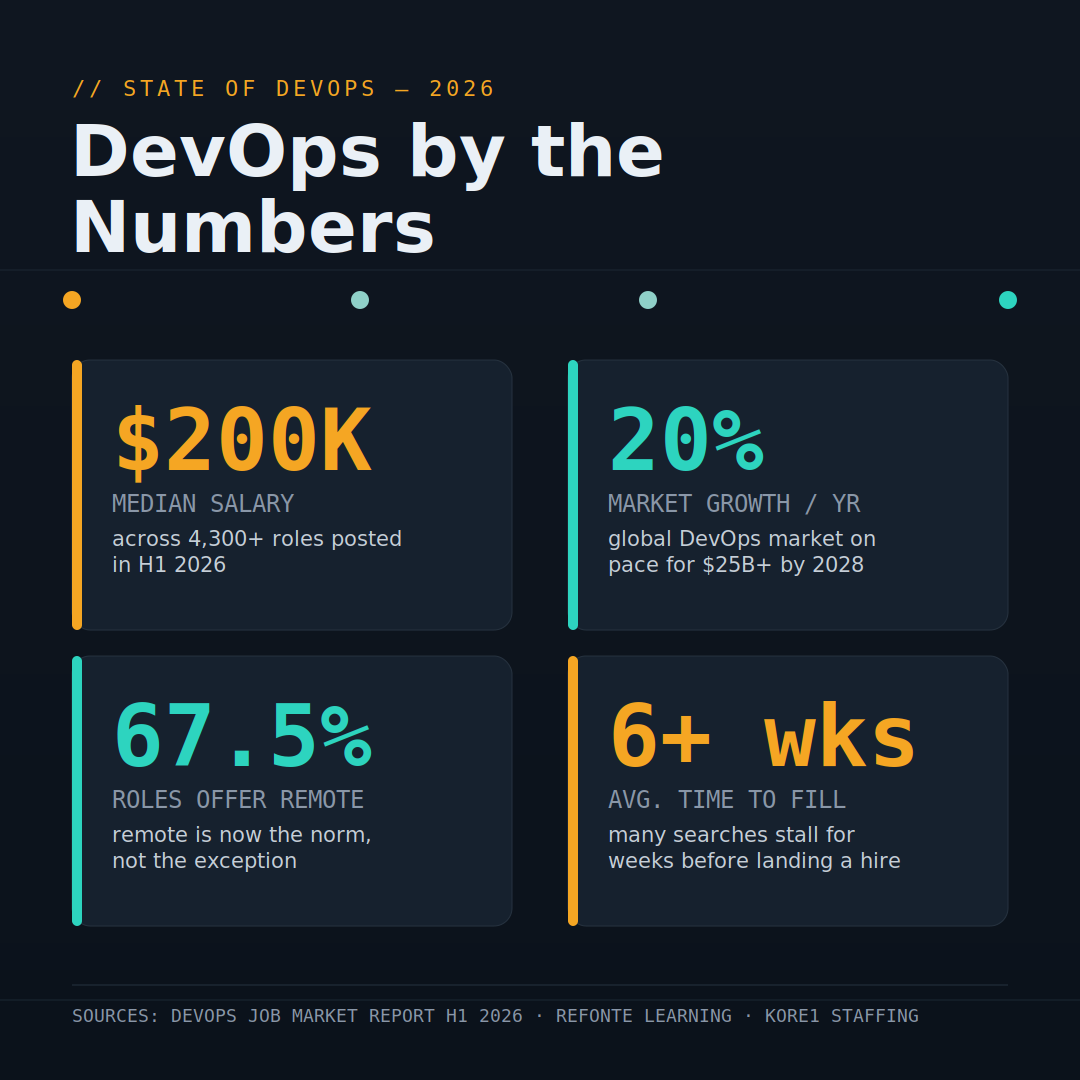
The numbers tell a different story. The global DevOps market is projected to jump from roughly $10 billion in 2023 to over $25 billion by 2028, growing at close to 20% a year. Median DevOps salaries in 2026 sit around $200,000, with senior and staff-level engineers pushing well past $300,000 in total compensation at top companies. Roughly two-thirds of DevOps roles now offer remote work, which has quietly made this one of the best "work from anywhere" careers in tech.
Here's the part that surprises people most: companies can't fill these roles fast enough. Recruiters report that a meaningful share of DevOps openings stay open for six or more weeks, and staffing firms describe the same pattern over and over — the pipeline of people with the right mix of skills hasn't kept pace with demand. It's not a shortage of interest. It's a shortage of the right combination of skills.
Who's Actually Hiring DevOps Engineers Right Now?
Every industry now runs on software, so every industry now needs DevOps. Financial services, healthcare, insurance, and media companies are bidding aggressively for talent, often outbidding pure tech companies because they're behind on infrastructure maturity and racing to catch up. Startups need DevOps engineers to move fast without breaking things; enterprises need them to modernize decades of legacy systems without breaking anything at all.
The role itself is also split into specializations. "Generic DevOps" is fading in favor of Site Reliability Engineering (SRE), Platform Engineering, and DevSecOps — each commanding a premium. DevSecOps specialists, for example, are earning tens of thousands more than standard DevOps roles at every experience level, because security folded into the deployment pipeline is no longer optional.
Which Skills Do You Need to Update Right Now?
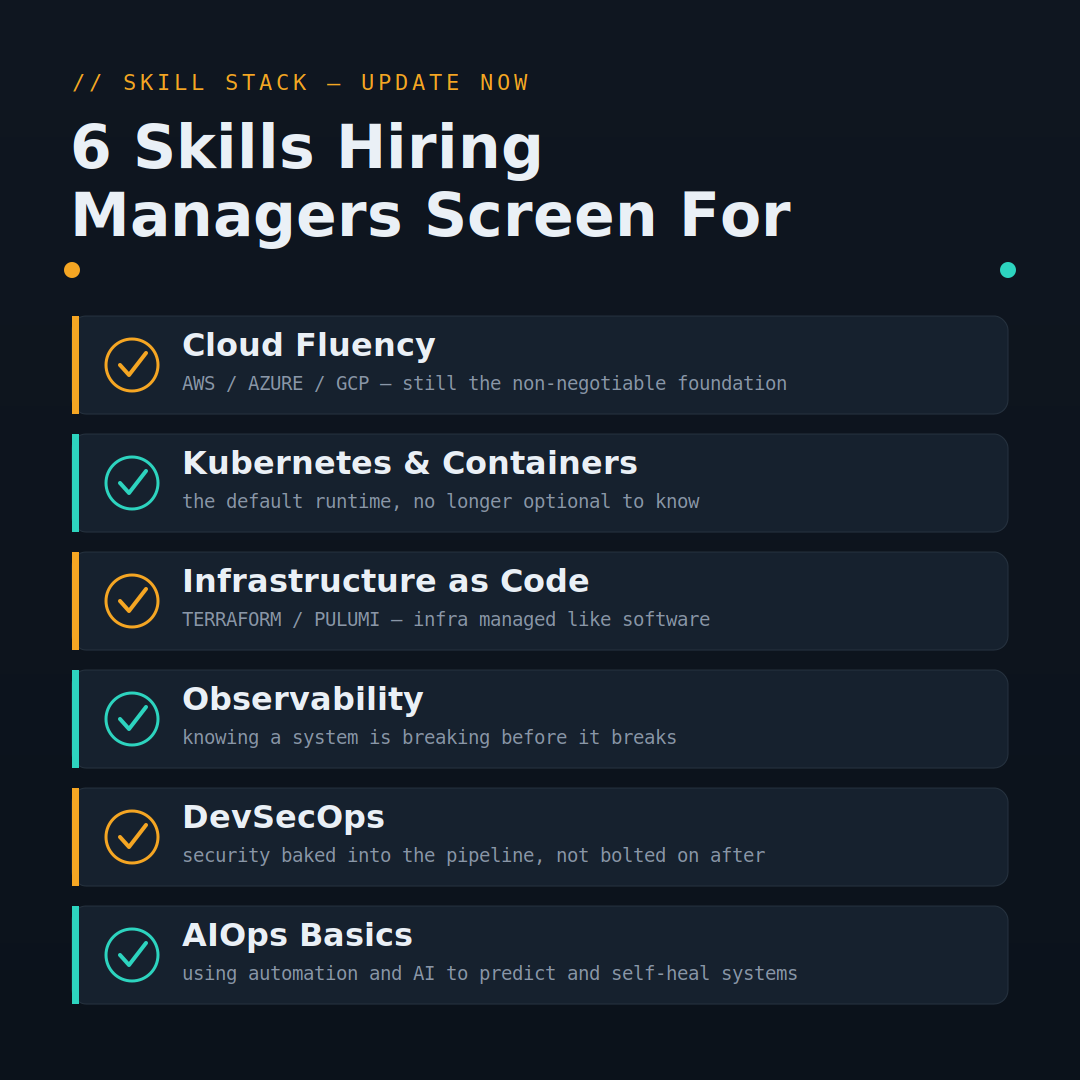
Job postings often list 15+ "required" skills, but hiring managers admit only a handful are truly essential. Here's what actually matters heading into the next few years:
Cloud fluency (AWS, Azure, or GCP) — still the foundation, not optional
Kubernetes and containers — now the default runtime, not a nice-to-have
Infrastructure as Code (Terraform, Pulumi) — infrastructure managed like software
CI/CD pipelines — deep, not surface-level, understanding
Observability and monitoring — knowing systems before they break, not after
Security fundamentals (DevSecOps) — baked into the pipeline, not bolted on
AIOps basics — using automation and AI to predict and self-heal infrastructure
Platform engineering mindset — building internal tools other engineers use to ship faster
What hiring managers actually look for is breadth with depth in one or two areas — engineers who understand the full path from code to production, not just one tool in isolation. Full-stack DevOps thinkers get hired faster and negotiate better offers than narrow tool specialists.
What Will DevOps Look Like Over the Next 5 Years?
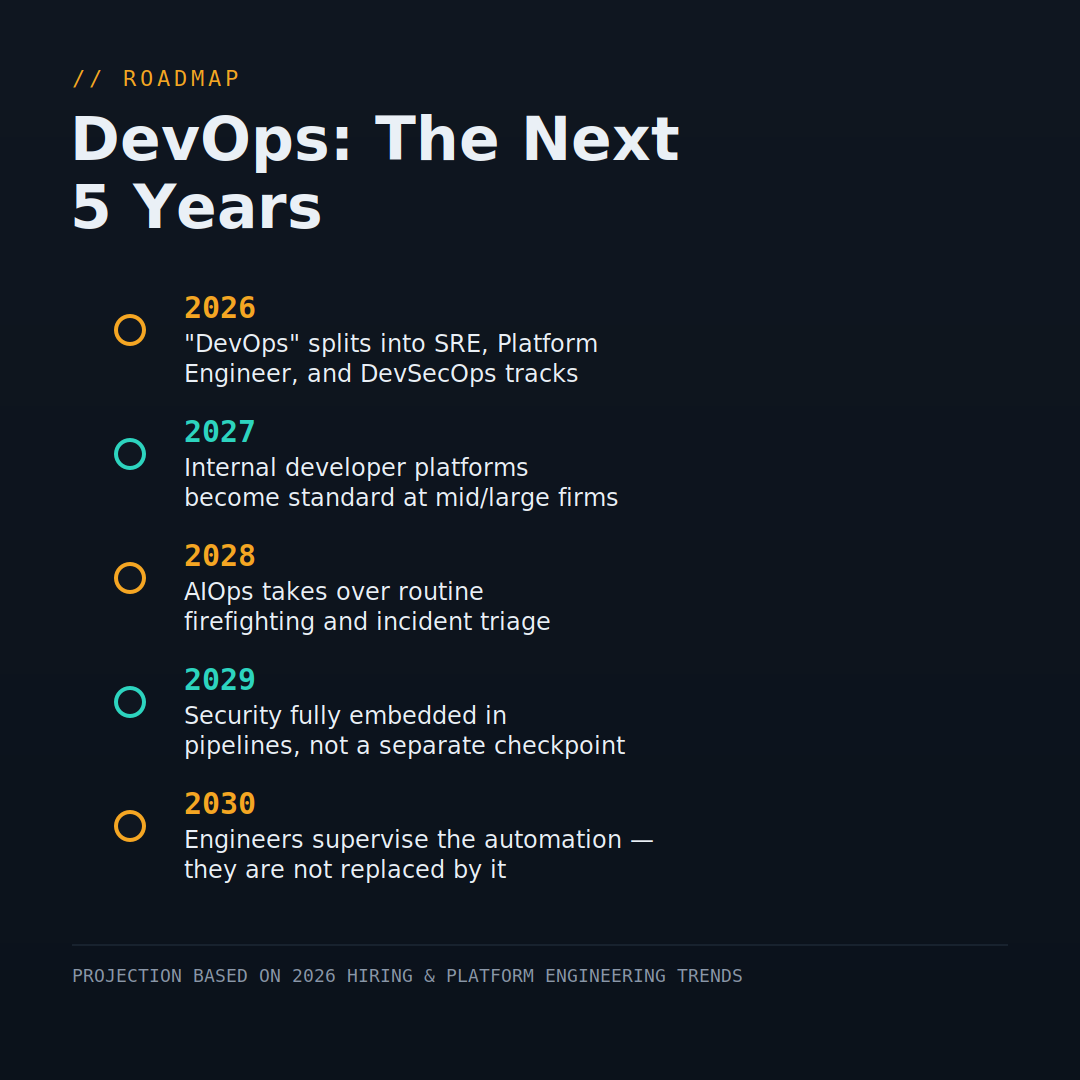
Expect the "DevOps Engineer" title itself to keep fragmenting into Platform Engineer, SRE, and DevSecOps roles, while the underlying discipline becomes even more central to how companies operate. Internal developer platforms will become standard at mid-size and large companies, AI-assisted operations (AIOps) will handle more routine firefighting, and security will be fully embedded rather than a separate checkpoint. Far from being automated away, DevOps engineers will increasingly be the ones building and supervising the automation itself.
The title may still sound unglamorous. The paycheck, the demand, and the staying power say otherwise.
The Final Takeaway
DevOps isn't underrated because it's small — it's underrated because it's invisible. Nobody claps for the pipeline that didn't break, the deploy that didn't fail, or the 3 a.m. alert that never fired. But invisible doesn't mean replaceable. It means essential. While everyone else argues about whether AI is coming for tech jobs, DevOps engineers are the ones building the guardrails AI runs inside of — and getting paid $200K+ to do it. If there's one job title worth taking seriously in 2026, it's the one you keep hearing dismissed as "not a real skill."
Enjoyed this breakdown? This is exactly the kind of thing I dig into every week — I learn it, research it, and share it straight with you, no fluff. Subscribe to my newsletter and get the next deep dive before anyone else does.
Weekly newsletter
Get the latest blog updates, practical hiring insights, and featured reads delivered straight to your inbox.
Read about our Privacy Policy.