 (1)-1791555126908-668402804.png "CyOpsPath logo")
-1785782676764-951724184.png)

Hi, I’m Akshata Bhat — a former Talent Acquisition professional, Founder of a job marketplace, and LinkedIn Thought Leadership Strategist for Executives.
Follow along as I build, learn, and share my journey on LinkedIn and Instagram.
Now, let’s dive in.
AI is booming. Hiring is frozen. Here's the real story behind the gap — backed by 2026 data.
Why do companies blame "AI efficiency" for layoffs when their revenue is growing?
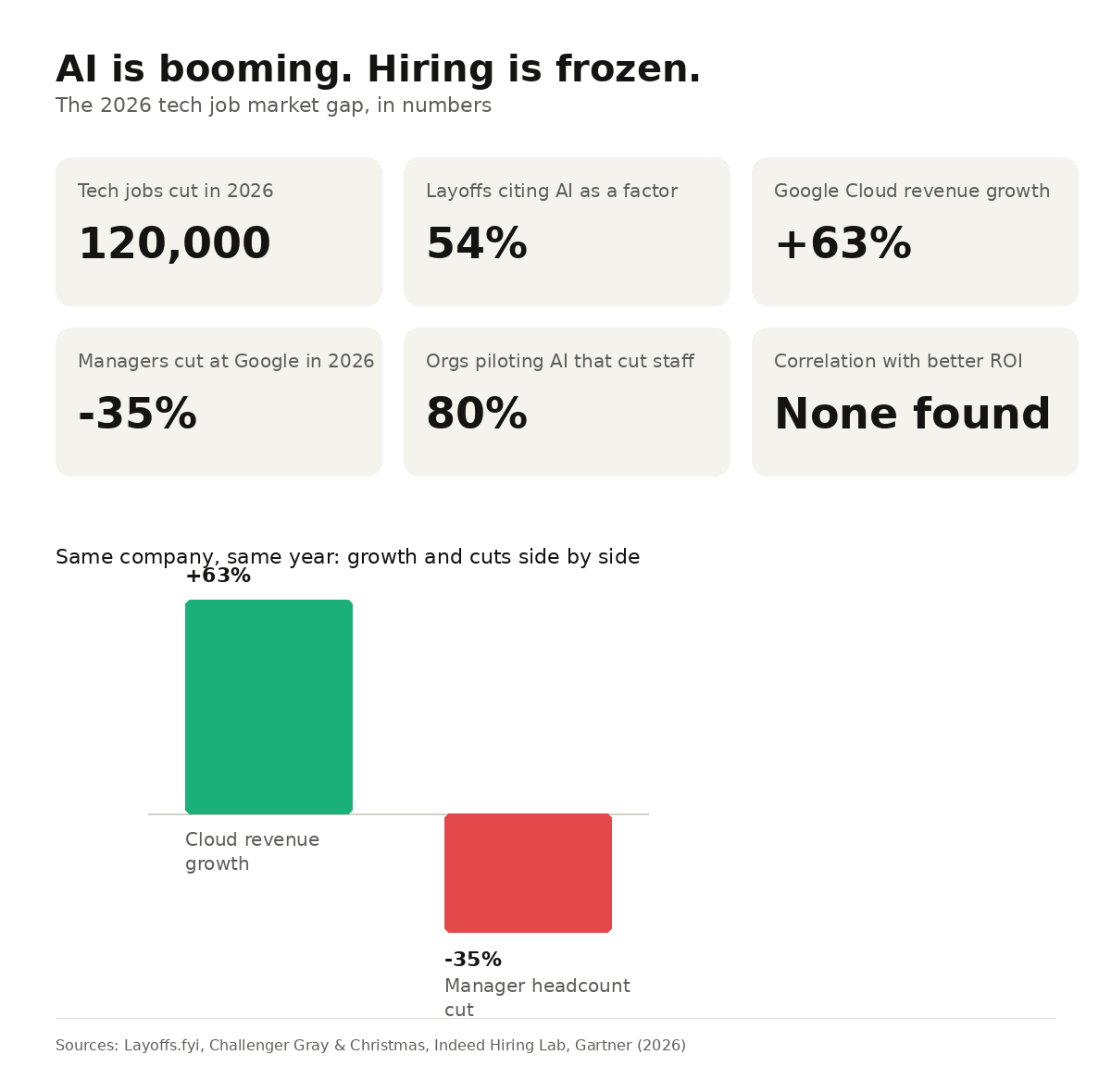
Roughly 120,000 tech jobs have been cut in 2026 so far, according to the Layoffs.fyi tracker, and more than half of those layoff events explicitly name AI or automation as a factor. But look closer at who's getting cut and when, and the "AI did it" story starts to wobble. Google's Cloud division grew revenue 63% and nearly doubled its backlog to over $460 billion this year — while the company quietly cut a third of its people-managers. That's not a business in retreat. That's a business restructuring around something it hasn't announced yet.
Is "AI efficiency" a real reason for layoffs or just a convenient excuse for past overhiring?
The theory: companies aren't firing people because AI replaced them — they're firing people to create the slack needed to test how much AI can replace, without the political cost of admitting it upfront. "AI efficiencies" is simply the more defensible line on a memo than "we overhired in 2021 and don't want to say so." One analysis of the layoff wave made almost exactly this point, noting that blaming AI reads better to investors than admitting a hiring binge went too far.
Has the tech hiring freeze actually started before this year's AI-linked layoffs?
Yes, and this is the tell. Indeed Hiring Lab's tracking shows software developer job postings have been flat to declining for over a year — well before this year's layoff wave even started. A freeze that predates the layoffs isn't a reaction to a sudden AI breakthrough. It looks more like companies parking headcount decisions while they figure out what they actually need.
What did Salesforce's Marc Benioff reveal about why companies are cutting engineering jobs?
He said the quiet part out loud. Benioff explained the company's reduced staffing needs by saying he needs fewer people, and Salesforce announced it would stop hiring software engineers altogether in 2025. Salesforce's Agentforce AI reportedly handled roughly half of a large batch of customer conversations at satisfaction scores comparable to human agents. That's not a company laying off because AI took the job — that's a company testing whether AI can take the job, and only then deciding whether to backfill.
Does AI actually deliver enough productivity gains to justify all these layoffs?
Not clearly. Gartner found that roughly 80% of organizations piloting autonomous AI systems have reduced their workforce — but found no correlation between those cuts and any improvement in ROI. That's the uncomfortable middle of this whole story: companies are cutting first and measuring results later, which is a strange order of operations if the technology were truly driving the decision.
Which engineers are most affected by the current hiring freeze and AI-linked layoffs?
Mid-level and junior engineers, disproportionately. Entry-level tech postings are shrinking even as starting salaries for the CS grads who do get hired are projected to rise nearly 7% this year — a shrinking door with a rising bar. Meanwhile, roughly 31% of layoffs tracked by Challenger, Gray & Christmas in a recent month cited AI, and tech accounted for close to a third of all 2026 layoffs industry-wide. The people surviving aren't necessarily the most AI-proof — they're the ones left standing while the test runs.
What should job seekers and engineers do while companies quietly test AI against their own jobs?
Stop waiting for a company to tell you honestly where you stand — they may not know yet either. Track what's actually being automated in your own workflow, not what leadership says in earnings calls. Treat "hiring freeze" and "AI-driven layoffs" as two separate signals worth watching independently, because right now, one is arguably being used to explain the other.
Is there a simpler, non-conspiratorial explanation for the tech hiring slowdown?
Sure — plenty of this is just cost discipline after a decade of cheap capital, dressed up in AI language because it sounds more forward-looking than "we hired too many people." Both explanations can be true at once. That ambiguity is exactly why nobody — workers or executives — seems to know what happens next.
Final Takeaway
The AI hiring freeze isn't proof that robots are taking your job — it's proof that companies don't know yet whether they will, and they're not willing to say so out loud. "AI efficiency" is easier to put in a press release than "we overhired in 2021" or "we're testing what we can automate before we commit to headcount again." Until the data on productivity gains catches up with the layoff numbers, the safest assumption for any engineer isn't that AI replaced you — it's that you're currently part of the experiment, and no one running it has published the results yet.
Weekly newsletter
Get the latest blog updates, practical hiring insights, and featured reads delivered straight to your inbox.
Read about our Privacy Policy.